
The Hairy giraffe… IN AUSTRALIA
After a long month spent in Indonesia (the end of which was difficult) and more than five months in Asia, it is with the greatest joy that we return to Western culture. Comfort food, drinkable water, and the disappearance of communication issues, our arrival in Australia is a much-needed break.
Well, not completely a break either. We spend a month traveling all over the north and east of the country. We drive around in our rental cars, music blasting, while taking a ton of photos of the varied landscapes around us. We also (occasionally) try not to get eaten by a crocodile, punched by a kangaroo, bitten by a snake, or stung by the biggest spiders we’ve ever seen.
Additionally, we get to know the Australians: kind, smiling, warm, funny, and welcoming. With a bit of practice, we even manage to understand their accent and expressions. Eventually, just like them, we quickly end up greeting them with a “G’day mate!”
How long? We spent a month in Australia. We focused our trip mainly on the Northern Territory and Queensland.
When? From mid-June to mid-July. This way, we avoid the cyclone season (November to April) in the north. It’s also winter (due to the Southern Hemisphere), so the climate is drier and cooler. For our itinerary, we mainly focused on the north and the east coast of the country, where the weather is generally milder than in the south, where it rains. It’s also a good season to visit the Red Centre, especially Uluru: we escape the stifling heat and the billions of flies (making hikes much more pleasant).
On the other hand, July is the winter school holiday period. So there were a few more people at the sites during the second half of our trip, although it was far from overtourism.
Ease of independent travel: 5 giraffes  Getting around Australia is super easy. First of all, it’s possible (and recommended) to rent a car to cover the (long) distances between the various points of interest in each region. The roads are easy to navigate and generally well-maintained.
Several domestic flights also connect the different cities. This saves a significant amount of time, as the country is enormous, and the distances to cover can sometimes be vast.
Costs: 5 giraffes (or even 6 or 7). Everything is horribly expensive. Whether it’s car rentals, food, gas, restaurants, or hotels, everything will cost you much more than elsewhere. For us, having just spent 6 months in Asia, the budget shock was significant.
Ease of communication: 3 giraffes  If you speak English, you’ll do just fine. However, you’ll need to adjust to the strong Australian accent, which adds a bit of difficulty. The fact that they use a lot of expressions and words unique to Australia also adds a certain communication challenge for non-native English speakers. Many Australians also speak very quickly.
Safety: 4 giraffes  The Australian wildlife can be intimidating. Many species of spiders and snakes are venomous and therefore dangerous to humans.
The roads are also dangerous. First, driving is on the left side. Then, it’s highly recommended not to drive at dusk or at night. Wildlife (especially kangaroos) roams the roads and risks being hit by vehicles. We also saw countless furry or feathered animals crushed on the roads.
In the parks of the Northern Territory, there’s also practically no internet or phone network. This isn’t ideal in case of emergencies, especially since the risk of accidents (road incidents, animal attacks, physical injuries, etc.) is very real.
On the other hand, there are no particular concerns regarding the risk of theft or assaults. Australia is a very safe country.
Health: 5 giraffes The Australian healthcare system is excellent.
Gay friendly : 5 giraffes Australia is a very open country for LGBT communities. Gay marriage is allowed, anti-discrimination laws exist, and gender change is also legal.
Travel ease: 5 giraffes Australia is a highly accessible country. The water is obviously drinkable (even in the desert). Food is varied and easy to access. The best idea is undoubtedly to rent a vehicle to maximize your independence. Plus, Australians are particularly kind and helpful!
Highlights: Edith Falls and its stunning landscapes, the endemic wildlife (even if it can be dangerous), Daintree Forest, Kings Canyon, and Australia as a whole.
Letdowns:  Kakadu National Park: there’s actually not much to do there, and the entrance fee is high; the lack of concrete information about Aboriginal culture and traditions; the poor value for money of accommodations (often very expensive for minimal comfort in a wealthy country); and the rain that prevented us from fully enjoying the east coast (even though winter is normally a good season for the northern part of the coast).
Check out our individual impression articles on Australia:
ONE-MONTH ITINERARY IN AUSTRALIA
Here is the detailed itinerary of our month in Australia:
Day 0: We arrived at Darwin Airport late in the evening after a 2.5-hour flight from Bali. We were a bit apprehensive due to the reputation of Australian customs. So, we declared our medications, our food (including a bag of loose-leaf tea bought in China and a bag of oatmeal purchased in Indonesia), and our wooden bracelets acquired since the start of our trip. We may have been lucky, but we passed through without any issues with all our belongings. Welcome to Australia.
We arrived at the hotel, in downtown Darwin, after midnight.
Day 1: We rent our first car. François, the only driver, has to get used to driving on the left side. It’s neither easy nor instinctive. Fortunately, the streets of Darwin are wide and fairly empty.

We visit the Museum and Art Gallery of the Northern Territory. It offers a wide variety of exhibits. Some focus on Australian wildlife, others on fossils, boats, or the period from 1911 to 1921.


The museum is free, and the exhibits are interesting. It also gives a taste of what we might see in the coming weeks.


We have lunch at a Domino’s. François has been craving pizza for weeks, and clearly, Benjamin is enjoying it too.

We take the car and head to Litchfield National Park, where we’ll start exploring tomorrow.


On the way, we come across controlled forest fires. They are used to reduce fuel (which would burn massively in case of a real fire), decrease unwanted vegetation, and improve wildlife habitats.


It’s impressive to pass so close to a fire. We even saw birds flying with burning branches in their beaks. The cheeky ones!
We enjoy our comfortable lodge.


Day 2: We are surprised because we thought we would have to show our tickets to rangers upon arrival in the park. Since we have no internet access, we also planned to stop at the welcome center to get more information about the different trails available. Unfortunately, none of that: the road leads directly into the park. There’s no welcome stand or ranger in sight.


So we head straight to Florence Falls. A small lake fed by the two waterfalls is open for swimming. Several tourists come to swim for a while. François goes in but doesn’t stay long: the water is cold.


Next, we head to Buley Rockhole. It’s a series of waterfalls where you can also swim or relax. The water is more pleasant. We both sit in the water, at the top of a waterfall, to fully enjoy the moment.


We then head to Wangi Falls. The view of the lake and the waterfalls is magnificent. However, swimming is prohibited due to the presence of crocodiles in the area. Unfortunately (or fortunately), we don’t see any, which allows us to return to the car in one piece.


We continue our journey to Tjaetaba Falls. To swim there, we have to hike up to the top of the waterfall on foot. The hike takes us about 45 minutes. Once at the top, the view of the park is very pretty. However, the swimming experience isn’t the most exciting. It’s the smallest pool we’ve seen today, so when several people are swimming at the same time, it gets a bit crowded. Additionally, since the waterfall is further down, the water is rather stagnant, making it full of insects, lizards, and algae…


We end the day with a quick stop at the Magnetic Termite Mounds. The termite mounds are huge and very tall. From the designated viewpoint, we can see nearly fifty of them scattered across the landscape in front of us. Unfortunately, we cannot get any closer. The vegetation is dense and wild, and we might risk coming face to face with an animal.


The day at the park was very enjoyable. We just find it a shame that the vegetation is unremarkable (it mainly consists of completely dry bushland and deciduous trees).
Day 3: We travel 300 km to reach the town of Katherine. The road is fairly quiet. The landscape is quite repetitive but still beautiful.


Katherine is a very small town. We spend the late afternoon in shops selling Indigenous handmade products. Everything is truly beautiful but very expensive.


We spend the evening celebrating Benjamin’s birthday. His birthday took place in Indonesia when we both had dengue fever. Now that we’re feeling better, it’s time to drink some wine (Australian, of course)!

Day 4: We drive 110 km to reach Elsey National Park. We plan to spend the day in the Mataranka section of the park.


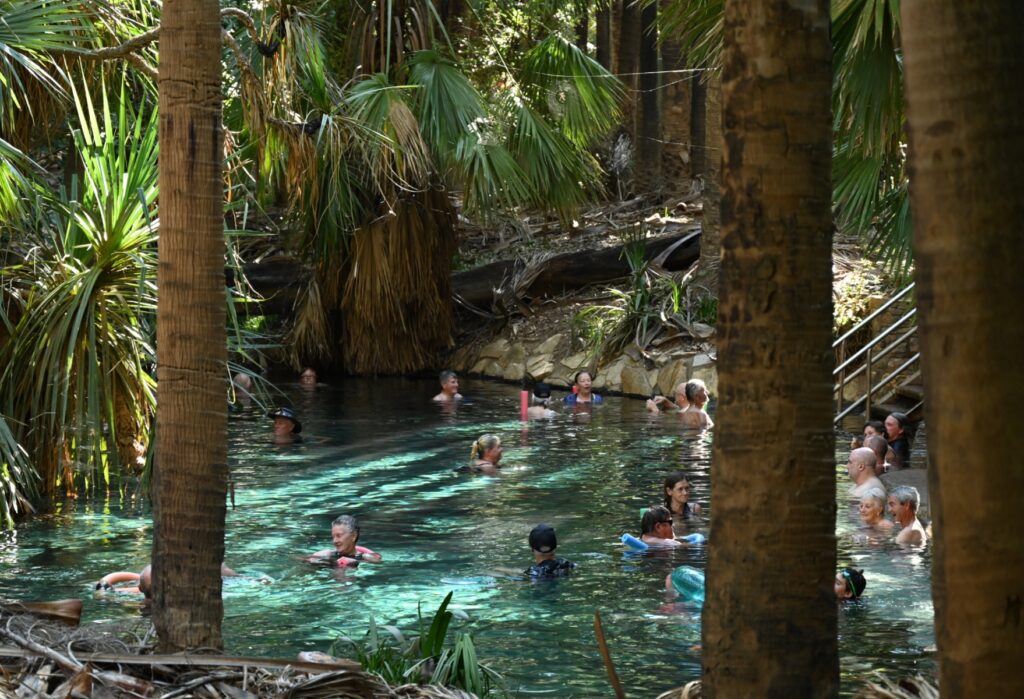
We start with the Thermal Pool, a natural hot spring river. The area is set up for easy access, with steps leading down into the water. What’s amazing is the water temperature (34 degrees Celsius at all times!) and its beautiful blue, crystal-clear appearance. Plus, no crocodiles inhabit this part of the river, making the swim incredibly enjoyable. We stay in the water for over three hours.

We then take a short walk nearby to reach Stevie’s Hole. The idea was to spot some crocodiles that live in this area. Unfortunately, we don’t see any.


We get back in the car and drive to the park entrance, to Bitter Springs. The water is the same as in the Thermal Pool. However, the environment is wilder and less suited for long swims.


We stay there for a little less than an hour before hitting the road again and heading back to Katherine.
Day 5: A 60 km drive takes us to Edith Falls. We hike the Leliyn Trail, which first leads us to the Upper Pool. The view of the waterfall is stunning. Swimming is also possible here. The water is cold, and the current is strong, but it’s easy to sit on rocks in the water and enjoy the experience. You can also sit on the cliffs to admire the landscape. We spend about three hours in this breathtaking setting.


We then continue the hike, which takes us down the cliff to a lake where the water from the previous waterfall flows. The scenery is less spectacular, although it is greener than at the top.


Swimming is also less enjoyable: the current is strong, the water is cold, and the bottom is quite deep. Additionally, crocodiles usually come out in the evening to feed in this area… So, we’re not exactly relaxed and don’t stay in the water for too long.


We then head back to Katherine, where we relax and soak up some sun by the motel pool.
Day 6: We drive 300 km to reach the heart of Kakadu National Park, in the small town of Jabiru. Our accommodation is there, and we will spend the next two nights. The drive is long and quite monotonous.


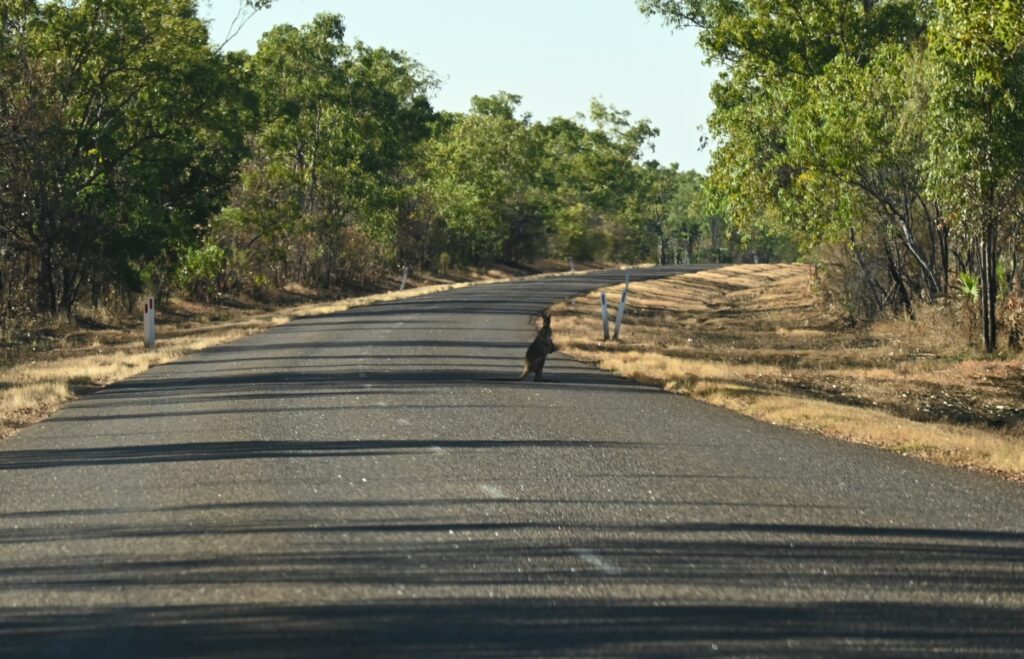
The scenery is quite beautiful, with red soil and green trees. We also spot a wild ox and a kangaroo, but we’re unable to take pictures due to the briefness of the encounters.


We stop at Bukbukluk, as there is supposedly a viewpoint and wild birds. However, we only stay for a few minutes—the viewpoint is unremarkable, and there are no birds in sight.
We then visit the Warradjan Aboriginal Cultural Centre. Photography is not allowed, and the experience feels a bit strange. We don’t really understand the purpose of the exhibition, as it seems all over the place. It showcases hunting weapons, musical instruments, and reptile eggs… but the connection between them isn’t clear. The explanations are also too poetic for our taste, making it difficult to truly learn more about Aboriginal culture. We leave feeling disappointed.
We then stop at Yellow Water, which is mainly a boarding dock for boat tours. However, there is a small walkway that allows us to follow the river for a few hundred meters.


We were able to spot a colony of more than fifty cockatoos as well as two crocodiles. It was impressive and, above all, very noisy—the cockatoos didn’t stop making a racket!



We finally arrive at our campsite. The accommodation is quite unusual—it’s basically a metal tent. The walls are made of perforated sheet metal, meaning we can hear everything happening outside. People can also see inside without any trouble. Not very private… and all for the price of a hotel room in Paris!


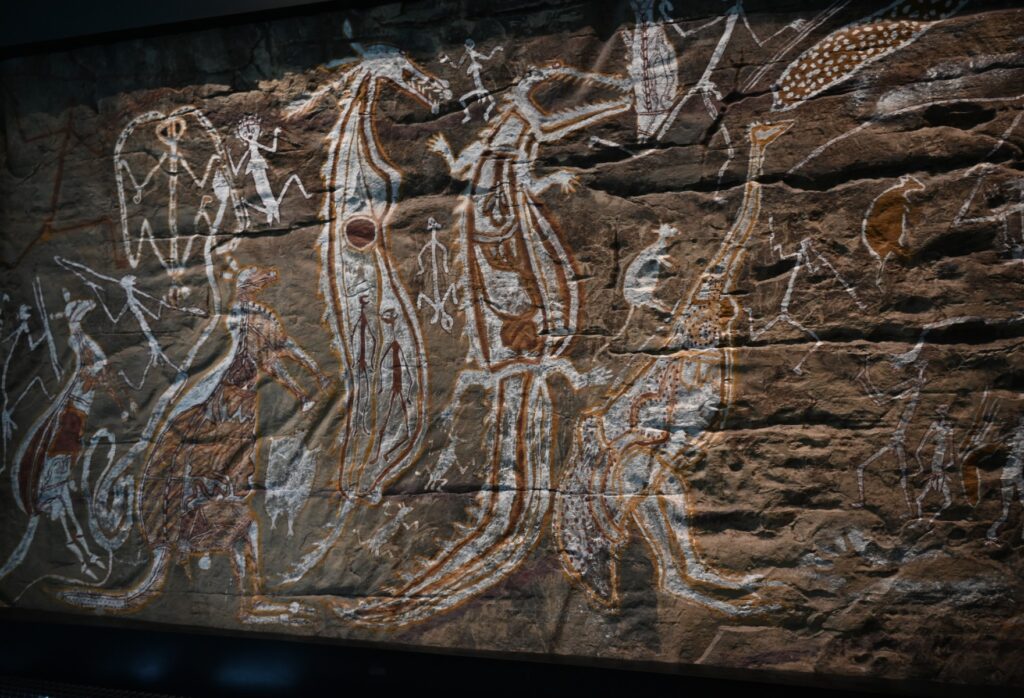
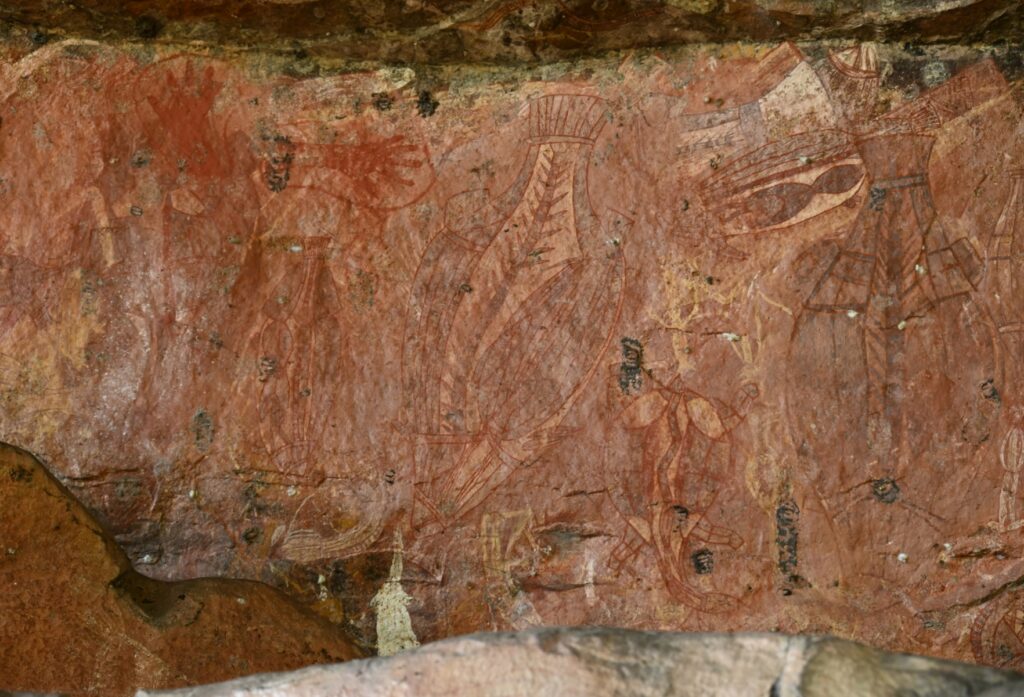
Day 7: After a quick grocery run in town, we head to Anbangbang Rock Shelter. This site is home to numerous rock paintings. Along the trail, at four specific spots, there are paintings on the rocks. Human figures, turtles, fish, snakes, and kangaroos are among the clearly visible artworks.


The paintings are truly magnificent and quite well preserved. The only downside is the lack of explanations—tourists have little idea of what they’re looking at or the history behind these artworks. It’s a shame. However, free tours are offered by the rangers.


The trail ends with a pretty nice viewpoint over the rocks.


We get back in the car and drive to the Nawurlandja lookout. This spot also offers a stunning view of the surroundings.


We then head to Anbangbang Billabong, a swamp where crocodile sightings are possible. We have lunch on the shore before setting off on a walk around the water. The walk is quite pleasant. We see many ducks and wading birds, but unfortunately, no crocodiles.


We get back in the car and head toward Ubirr.


This part of the park features a loop hike with more rock paintings and an elevated lookout point. The paintings are harder to see than those we visited in the morning. Some are painted on the “ceiling” of rocky overhangs that we can’t step into. They are also much more abstract and faded. However, we can still make out fish and kangaroos. Unfortunately, they are not as beautiful as the ones we saw earlier.


However, the lookout point is very impressive and offers a stunning view of the surroundings.


We end the day with a visit to Cahills Crossing. We decided to go because the online reviews were glowing. We expected to see crocodiles—but not at all! It’s basically just a viewing deck overlooking the river (with no crocs in sight). Additionally, a large part of the site is off-limits to non-Indigenous people—only Aboriginal people are allowed to cross the bridge over the river.


A very short walk through a field leads us to a boarding dock, which isn’t particularly interesting. So, we hop back in the car and head back to the campsite.
Day 8: We have to return to Darwin because we need to drop off the car by 5:00 PM.


On the way, we stop at Mamukala, our last stop in Kakadu National Park. There is supposed to be a 45-minute walk through the bush and vegetation, along with a birdwatching lookout. The walk is terribly boring—there’s nothing to see, and we’re just walking under the scorching sun. The viewpoint overlooks a swamp with several ducks and wading birds, but it’s nothing special. We don’t stay long.


We get back on the road and stop at Mary River National Park. Our first stop is Mary River Billabong. A 1 km trail loops around the swamp. The walk is really nice—we’re fully immersed in nature, surrounded by lush vegetation and water. We also come across some wildlife: a snake hunting a grasshopper, a crocodile, and some kangaroos. Unfortunately, we can’t take pictures of the last two. As soon as they spotted us, they ran away.


We then plan to visit Bird Billabong, located nearby, to see some birds. However, upon arrival, we realize that reaching the swamp requires a walk of over 4 km… So, we decide to skip it.
We continue our journey toward Darwin.


About 60 km away, we reach Fogg Dam Reserve, where we decide to stop. Just past the entrance, a narrow road leads to the Pandanus lookout. On either side of the road, there’s water filled with water lilies, birds, and even wild calves. Unfortunately, we don’t spot any crocodiles. However, once we reach the lookout, we come across more than a dozen kangaroos. Taking photos is tricky—whenever we get a little closer, they hop away!


We get back in the car and complete the drive to Darwin. In this first part of our trip to Australia, we have covered a little over 1,600 km.
Day 9: We spend the morning strolling around Darwin. The city isn’t very big, but it has a nice atmosphere. We visit the waterfront, which is quite beautiful. Too bad swimming is forbidden—gotta love the man-eating wildlife!


We also spend some time in Aboriginal craft shops. The artwork is truly beautiful, especially the pieces featuring animal designs. However, the prices are extremely high—you need to budget around 500 euros for a medium-sized canvas.


In the middle of the afternoon, we take our flight to Cairns. The flight is smooth and lasts two hours.


Upon arriving at the airport, we rent our second car to drive to our hotel.

Day 10: We head north from Cairns, planning to spend a few days in Daintree National Park. The road is nothing like the ones we drove around Darwin. Here, we are surrounded by lush rainforest—huge, towering, vibrant green trees. There are also many more cars on the road. For part of the drive, we can even see the ocean.


We stop at the Rex Lookout to enjoy a stunning view of the ocean.
We then head to Mossman Gorge, the highlight of our day. The site offers several viewpoints over the river and a 2 km walk through the rainforest. Much of the trail is fully developed, with asphalt paths and a suspended metal bridge. There are also quite a lot of tourists, which is a big change from our time in the Northern Territory, where we were often alone on the trails.


The walk is very enjoyable—it’s great to stroll through a rainforest at less than 25 degrees. It’s a far cry from Borneo with its 40-degree heat and 150% humidity…


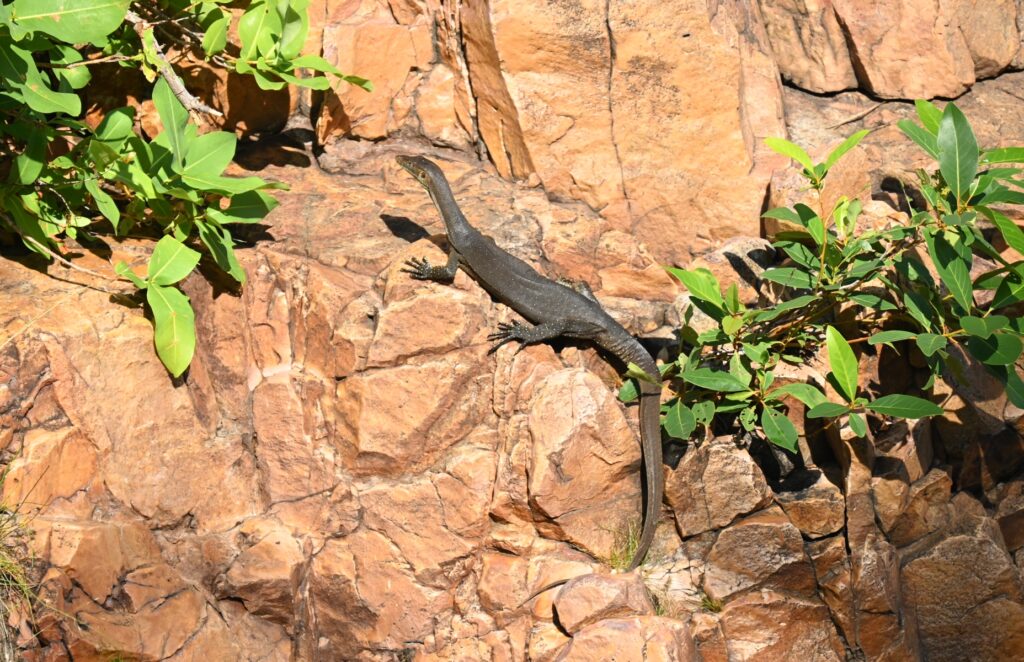
However, we were hoping to see cassowaries, but unfortunately, that didn’t happen. Aside from 10 cm-long spiders (!), we didn’t spot any animals.


We then continue driving north to reach our bed and breakfast, located not far from Cow Bay.


We take the time to enjoy the surroundings.


Day 11: Our first stop is Thornton Beach. The sand is white, and the sea is quite calm. However, swimming is not recommended (as is the case all along the coast) due to the possible presence of sharks and jellyfish.


We then continue to Madja, where we can take a walk through the rainforest. Like yesterday, everything is well-marked, and the entire walk is on a boardwalk. Despite this, the mangrove is truly beautiful, and the walk remains enjoyable.


Next, we head to Dubuji. First, we take a look at Myall Beach, which, like the other one, is very beautiful. Then, we walk along the trail that winds through the forest.


Once again, the sounds of animals are everywhere—chirping, croaking, singing… the forest is quite noisy. We walk slowly, trying not to startle the wildlife in the hopes of spotting something. Unfortunately, aside from spiders and a caterpillar, we don’t see anything.


We end the day at Kulki Beach near Cape Tribulation, which, like the others, is stunning.


Day 12: We leave Cow Bay and head to Atherton. The landscape is quite different— the rainforest has been replaced by orchards and sugarcane fields.
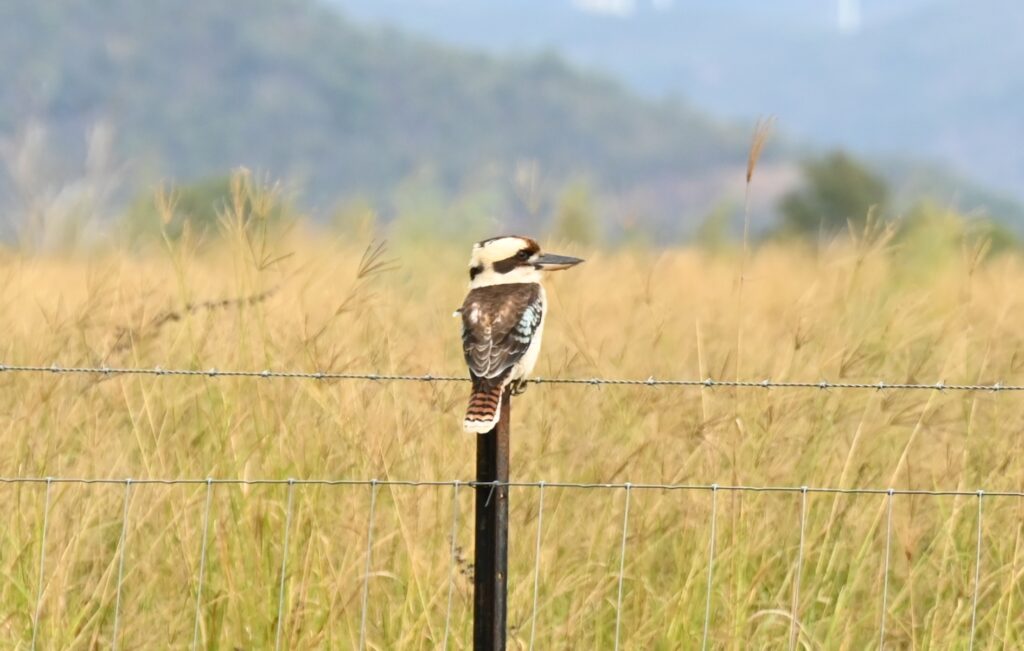

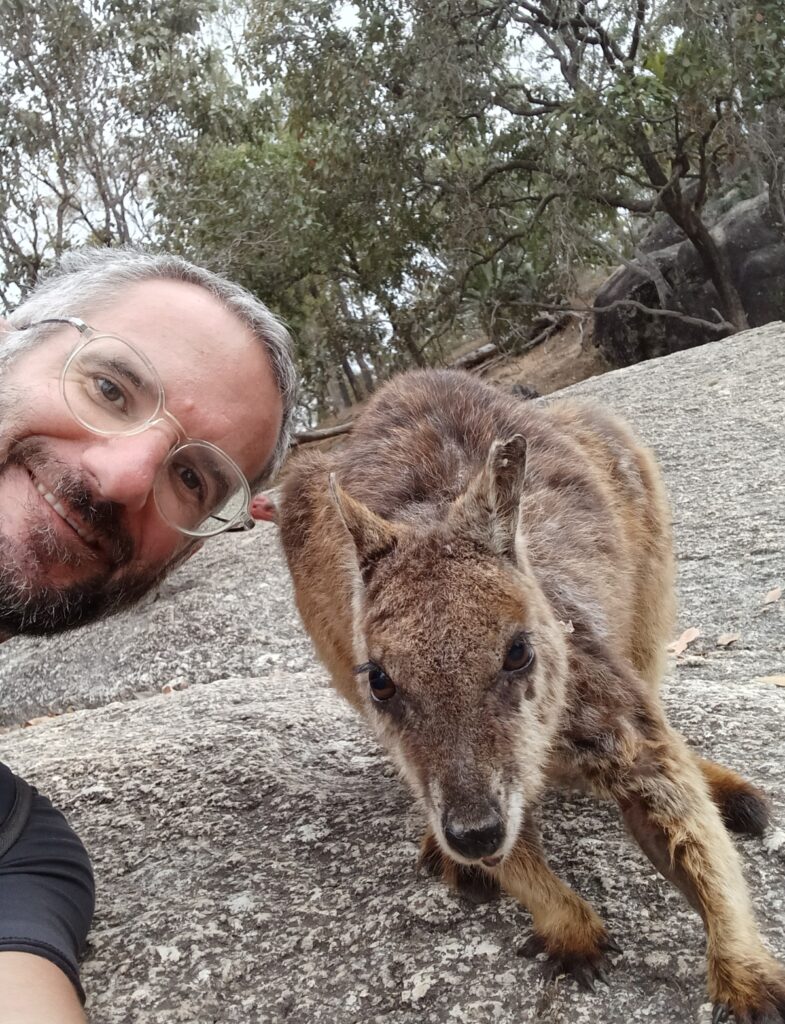
We stop at the Granite Gorge Nature Park. It’s primarily a campground, but what interests us is the trail just behind it. And most importantly… the rock wallabies. These marsupials are no more than 60 cm tall and live among the rocks.


We also have the opportunity to feed these animals (with special food purchased at the reception). They are friendly and quickly approach us as soon as we crouch on the rocks. This encounter is very enjoyable. They are not aggressive at all, eat straight from our hands, and even allow us to pet them.


The campsite also offers two hiking trails. The first one, the yellow trail, is very easy. The second one, the red trail, is quite challenging as it mainly involves jumping from one rock to another, which is not always easy.


We will spend 4 hours at the site (mostly sitting on the ground feeding our new friends). The entrance fee is a bit high, but the experience is really enjoyable.

Day 13: A drive of just over 150 km awaits us today. We start with our first stop at the Curtain Fig Tree. It is a massive fig tree, standing 50 meters tall with a circumference of 59 meters. It is also made up of numerous roots that extend from high up and reach down to the ground, hence its name.


We make a second stop at the Malenda Falls.


They are surrounded by a tropical forest that is home to tree kangaroos, a type of kangaroo about 60 centimeters tall that lives in trees. It has enormous claws that allow it to climb easily.


So, we spend the entire walk with our eyes lifted toward the canopy. Unfortunately, we don’t see any. However, we do spot a few turtles paddling in the river, as well as some pademelons, another type of hopping marsupial. These little ones are very skittish, making it difficult to take photos.


We then take a scenic drive that passes by three beautiful waterfalls. The first, Millaa Millaa, is the most accessible—only a few steps separate it from the parking lot. The waterfall is quite wide, and swimming is easy here. There’s even a grassy area right in front where you can sit and relax. However, we skip the swim since the weather is cool and the water is cold.
The second waterfall, Zillie, is more challenging to access. While a viewing platform right next to the parking lot offers a view from the top, reaching the river below requires climbing down slippery rocks and tree roots. However, the view from below is truly beautiful.


The last one, Ellinjaa, is also easy to access. A staircase leads from the parking lot down to the river. Here too, swimming is possible without any issues.
Our next stop is Crawford’s Lookout. From the road, we can admire a body of water located at a certain distance. To get closer, there is a nearly 2 km trail that winds through the forest. We walk for about thirty minutes, hoping to spot cassowaries—but we don’t see any.


We end the day in the hot tub of our motel in Mission Beach.


Day 14: Our goal for the day is to see a cassowary. The colorful cousin of the emu lives in the rainforests of northern Queensland, and since we are continuing our journey south towards Airlie Beach, this is our last chance.
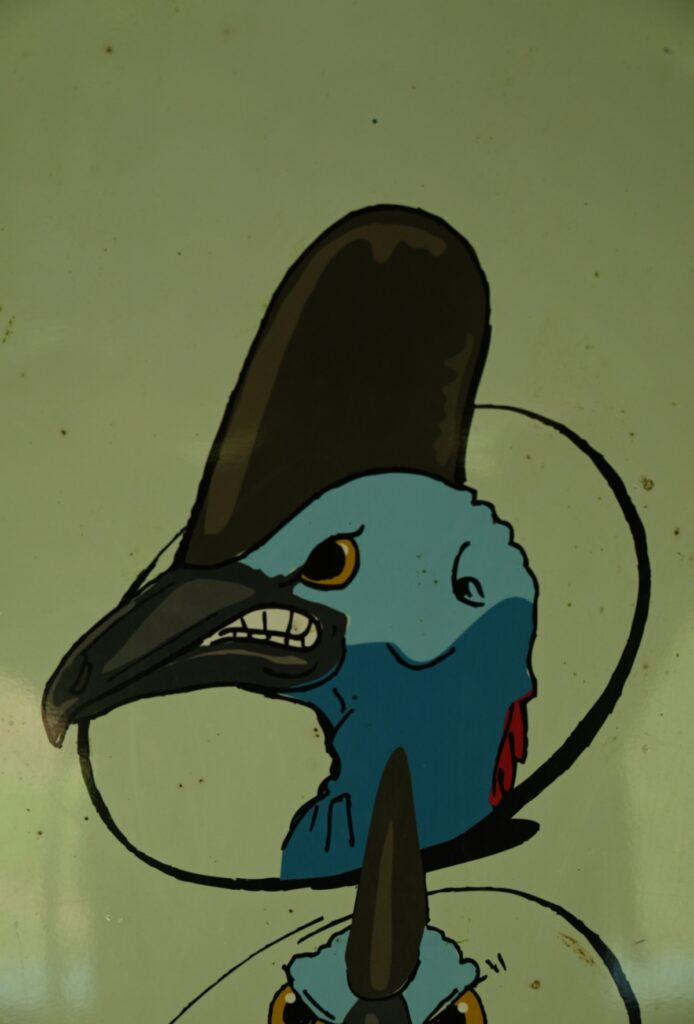

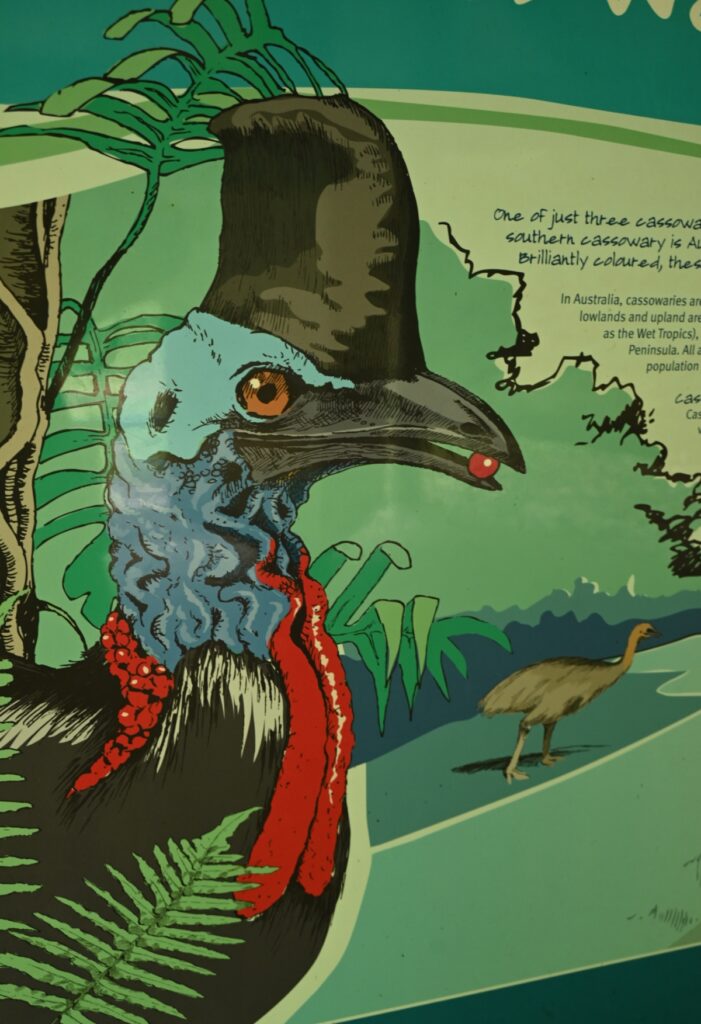
Mission Beach is cassowary territory. They are even represented everywhere throughout the area.
So, we set off on the Lacey Creek trail. For 1 km, we walk through the rainforest, hearing plenty of sounds but seeing nothing.


We cross the street to take on the Dreaming Trail. It’s a 3.2 km walk one way, so we walk for about 45 minutes before turning back… without seeing anything! The only cassowaries we’ve seen in Australia are on roadside signs or posters. Disappointed and convinced that the only cassowary we’ll see on this trip was at the Birds Park in Bali, we get back in the car.
We clear our minds by going to sit on the beach.


After lunch, we tackle the 230 km we need to cover today. Suddenly, just a few kilometers before leaving the forested area, we see a large animal walking on the roadside… a cassowary!! Finally!!! François quickly stops the car (creating a small traffic jam) while Benjamin fires away with his camera. (The car behind us was kind enough not to honk and even turned on its hazard lights to buy us a few extra seconds—thank you, Australians!).

We then continue our journey to Townsville (a name that sounds like it came straight out of a Lucky Luke comic), where our hostel is located.


We stop to buy ingredients for dinner just before checking in. On the menu: kangaroo meat and a bottle of Shiraz. Welcome to Australia!


Day 15: We had planned to spend the day on Magnetic Island, but continuous rain is now expected. So, we take advantage of the fact that it hasn’t started raining yet to go for a walk along the seaside at Strand Park.
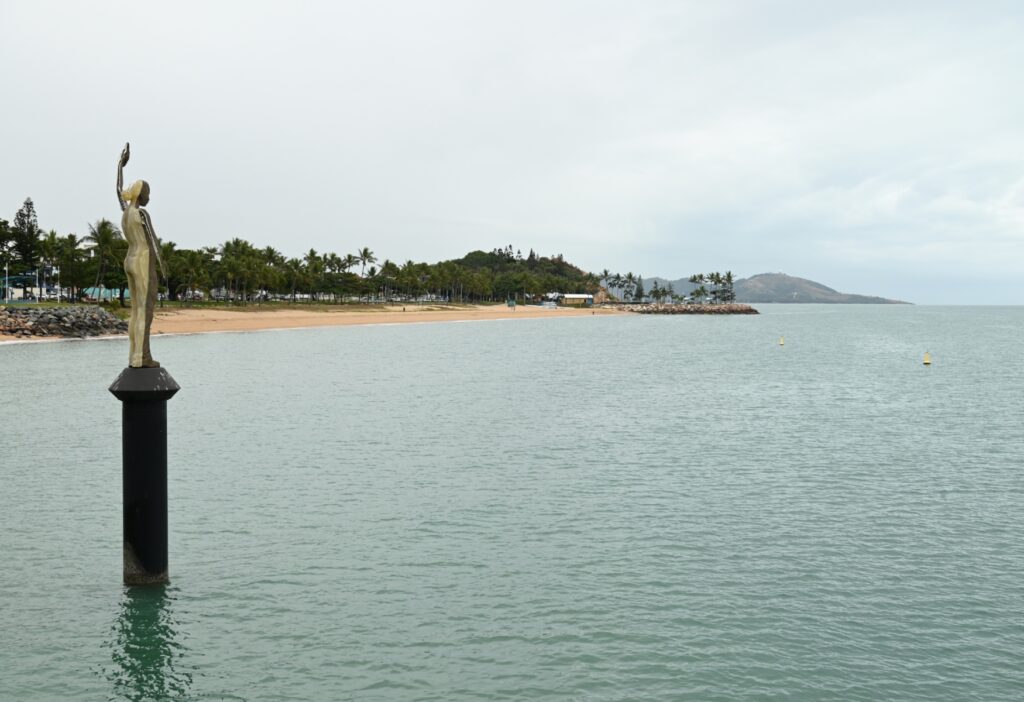
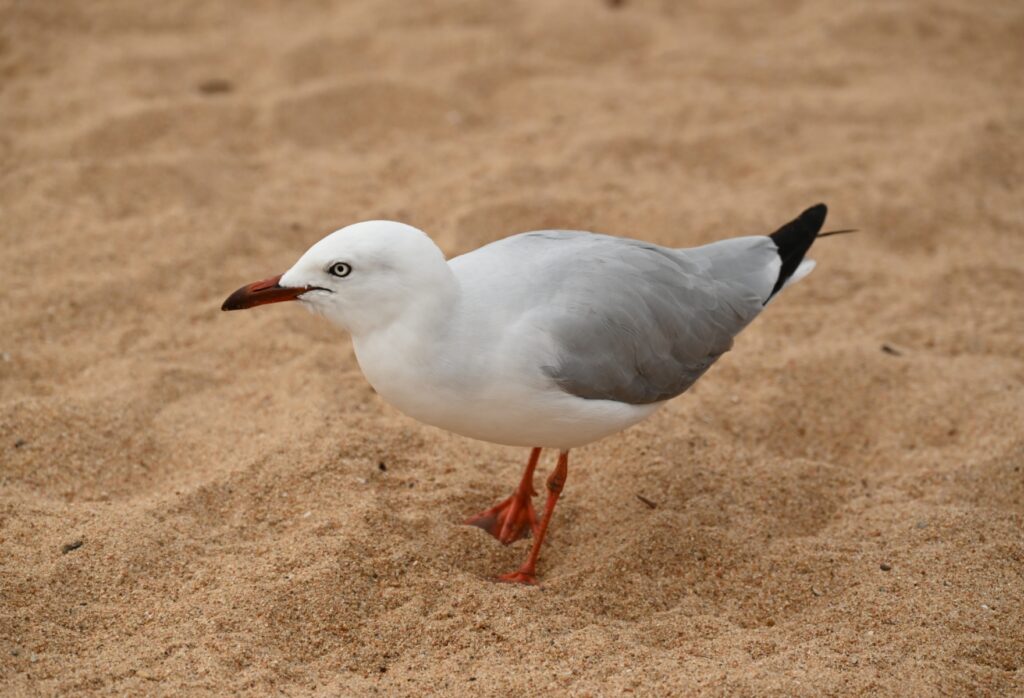


We have fish and chips for lunch before heading back to the hostel in the rain.


We spend the afternoon working on the blog and updating the budget.
Day 16: We have to drive a little less than 300 km to reach Airlie Beach. The journey takes place under the continuing rain.


We stop for lunch in Bowen, a town known for being the filming location of the movie Australia with Nicole Kidman and Hugh Jackman.


Locally, the town is known for its mango production and heavily promotes it.


As a port city, we also take the opportunity to get our fill of fish.


Day 17: We had decided to stop in Airlie Beach to fly over the Great Barrier Reef and enjoy its crystal-clear waters. Unfortunately, the rain persists, and the sky remains very threatening even during brief lulls. So, we’ll be staying on the ground. (At this rate, we’ll have to come back to Queensland on another trip).


We take advantage of a brief lull in the rain to visit the beach, stroll around town, and grab some lunch.


The rain starts after lunch, so we head back to the hotel.
Day 18: The weather is still gray.
We drop off a package at the post office for shipping to France (hopefully the last one of the trip). Inside, along with what we bought here, are souvenirs from Japan, Singapore, and Malaysia.


We head back to town and the seaside.


We spend the late afternoon at the hotel working on the blog.
Day 19: The sun finally decides to show itself… on the day of our departure for Sydney. We spend a few hours in the center of Airlie Beach before returning the car at Proserpine Airport.
In the end, we traveled 1,188 km on the roads of Queensland.
At the airport, we get a glimpse of the underwater scenery, which looks magnificent and that we may see one day.


A flight of about 2 hours and 30 minutes takes us to Sydney, where we spend the night at the airport.


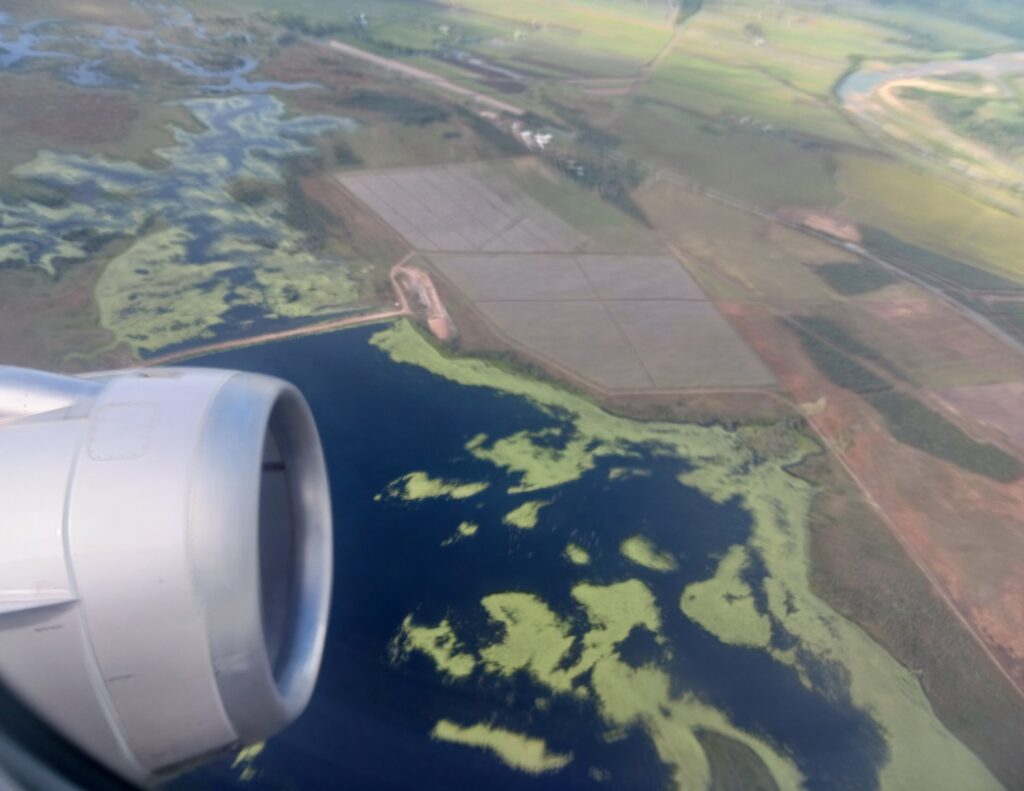

However, we do contribute to the local economy…


Tomorrow, we are heading back to the Northern Territory!
Day 20: Here we are at the airport again. A 3.5-hour flight awaits us to Uluru, in the heart of the country, right in the Northern Territory.


We pick up the car before heading to our campsite.


Yes, for the next week, we’ll be in camping mode (it’s the most affordable option here, though still quite expensive). However, we’re not really the tent type. We prefer a minimum of comfort rather than freezing. Another road trip awaits us tomorrow.


Day 21: We wake up ready to tackle the slightly less than 300 km that separate us from Kings Canyon. The clouds are present, adding a touch of color to the sky.


The road is different from what we have experienced so far. Here, the earth is red (or rather dark orange). The tall green trees of the coast have given way to dry, yellowed shrubs. The road is also busier than in the Top End (Darwin). Moreover, we don’t see any animal carcasses, which were quite common at the beginning of our trip. Perhaps wildlife is less present here, or maybe it has learned to stay away from the road?
We stop several times to take photos. At the same time, we notice that the sky is becoming increasingly overcast. Nothing threatening, but the light has changed, and the air has cooled down.
We arrive at the campsite and settle into our tent for the next two days. Two beds, a canvas, a heater—it’s minimalist, but it fits perfectly with the desert-western landscape surrounding us.


We take a quick walk around the site, but the cold has intensified. We head back to take shelter.


Day 22: We wake up early under a bright blue sky to enjoy the breakfast served. François is in heaven—his plate is filled with scrambled eggs, potatoes, sausages, bacon, and baked beans. Long live the English influence!
Satisfied and full of calories, we set off to explore Kings Canyon.


We begin with the Kings Creek Walk, a short and easy stroll at the bottom of the canyon. Since the sun hasn’t fully risen yet, much of the canyon walls remain in the shade.


We continue with the Kings Canyon Rim Walk. This loop trail allows us to walk around the top of the canyon. While the ascent is quite steep, the rest of the hike is relatively easy.


Several viewpoints are set up along the trail to fully appreciate the splendor of the scenery. Numerous informational panels about the canyon’s formation, geology, wildlife, and flora are scattered throughout. Easy to understand, they add real value to the experience.


After walking the 6 km around the crater, we decide to return to its center to enjoy the early afternoon light. It’s much more beautiful.


We stop at Kathleen Springs on the way back to the campsite. It is a spring that flows inland, where animals can sometimes be seen coming to drink. The walk is very easy, and the scenery is nice.


Back at the campsite, since it’s not as cold as the day before, we go for another walk around the site.


At nightfall, we step outside to admire the starry sky of the Southern Hemisphere, so different from what we are used to seeing. The cloudless sky allows us to see countless stars. The most beautiful sight is the Milky Way, which we first glimpsed during our trip to Namibia. Unfortunately, without the right photography equipment, we are unable to capture the moment.
Day 23: After another serving of baked beans and sausages, we head back to Uluru. This time, the drive takes place under a completely blue sky.


Unlike the other national parks we have visited so far, our ticket is checked as soon as we arrive at Uluru-Kata Tjuta National Park. Once the check is complete, we head toward the Mala car park. Our plan is to walk along the southern side of the rock.
It’s important to know that Uluru is a sacred site for the local Aboriginal people. Since 2019, climbing the rock has been prohibited. Additionally, certain areas are off-limits, and it is forbidden to photograph, film, or sketch them.
While the rock is truly magnificent, especially due to its size and color, the hike itself consists of walking around it on flat terrain, with vegetation mostly limited to dry, yellowed bushes. Nothing particularly thrilling…


We walk for about 30 minutes before turning back (we will do the full loop two days later). We then head to the cultural center to learn more about the local people’s culture. Another disappointment. Just like in Kakadu, nothing is shared about their history, traditions, or customs. Photography is also prohibited.
We stop by the souvenir shop, thinking of buying some Aboriginal art or a local trinket. The exorbitant prices make us walk right back out.
We leave the park but stop to take a few photos at the designated sunset viewpoint. We plan to watch the sunset from there tomorrow.


Day 24: On the way to Kata Tjuta. It is a massif of dome-shaped rocks.
Two hikes are available to us: a 7.4 km loop around the massif and a 2.6 km round-trip into its gorge.


We start with the loop and thoroughly enjoy the landscape. The experience is much more pleasant than walking around Uluru. Here, the trail climbs and zigzags through rocks and along the rocky wall. The scenery is also stunning. Although less imposing than Uluru, the site gives the impression of swallowing up the hiker. The walls are very tall and have a beautiful ochre-red, sometimes pink, hue.


We finally stop at the Karingana lookout before turning back.
The hike in Walpa Gorge is a bit less enjoyable. The wind is strong and cools the air. Unfortunately, the colors are less striking—since the sun has already shifted, the area is now covered in shadow. The walk is easy.


We finally return to the Uluru area to enjoy the beautiful sunset.


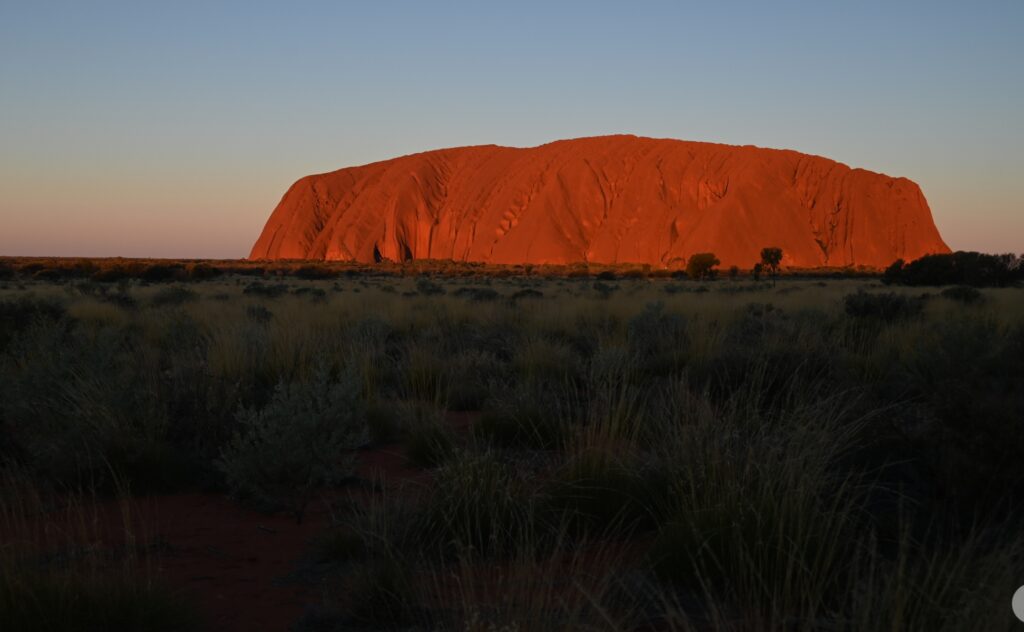


Day 25: Last day at Uluru-Kata Tjuta National Park. We decide to walk around Uluru. The impression we had two days ago is confirmed: it feels more like a cycling path than a hiking trail. There are few pedestrians but many cyclists. Moreover, the hike itself is not very interesting.


In the northern section (roughly between the starting point at Mala Puta and the Kuniya Piti emergency post), the trail is too far from the rock to admire its details and too close to get a full view. The flora is sparse, and the fauna is absent (at least in winter), which doesn’t add much to the walk. In the southern section, from Kuniya Piti to Mala Kuta (especially the Kuniya Piti-Pulari segment), we are closer to the rock and can observe all its irregularities. The flora is also more diverse.


Something to note: the circuit has almost no amenities. There are only three benches (located at the emergency posts) throughout the entire northern section. These benches also provide the only shaded areas, which is quite surprising for a place where temperatures can reach up to 40 degrees in summer. The southern section has more spots to rest.
Rock paintings can also be found in Kantju Gorge and along the southern part of the trail.


The Mutitjulu Waterhole is nice, and the presence of a water source contrasts with the surrounding arid landscape.
Day 26: We take one last look at Uluru from a viewpoint located near our campsite.


We return the car at the airport, from where we take a 2h40 flight to Sydney. In total, we have driven 926 km on the roads of the Red Centre.


In Sydney, we head to the hotel where we will be staying for the next few days. We don’t forget to open a bottle of Australian wine to celebrate the occasion.

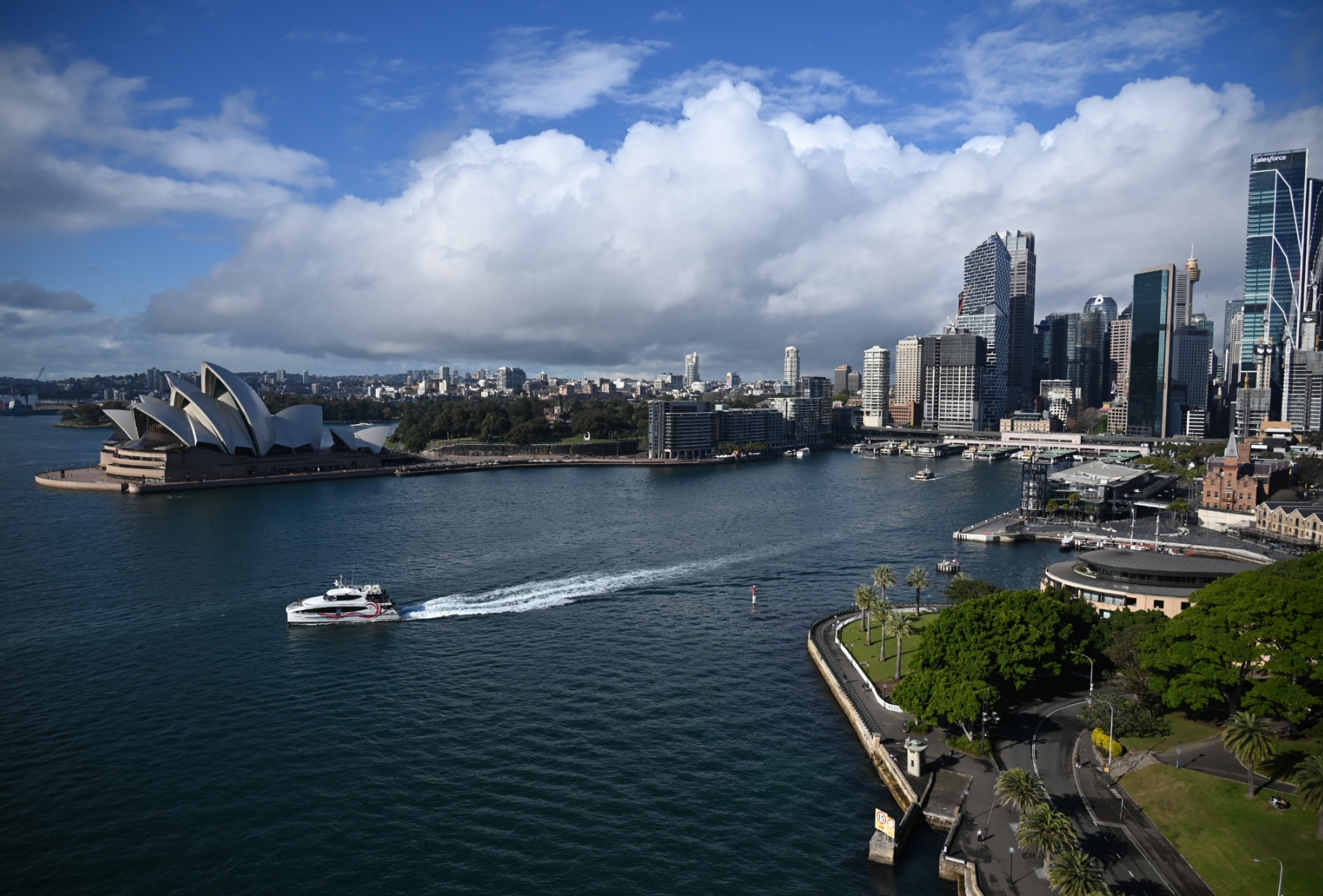
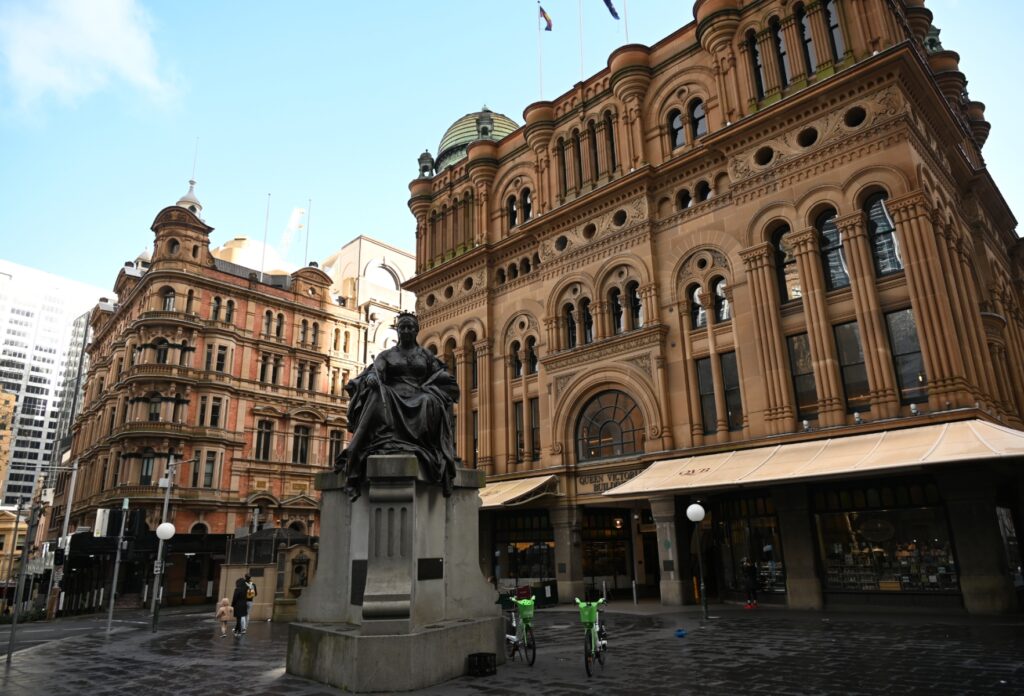
Day 27: The weather forecast had predicted rain for our entire stay in Sydney, so we are pleasantly surprised to wake up to a blue sky. We rush to the Opera House to see it under the sun. Leaving from Chinatown, where our hotel is located, we pass by Town Hall, the Queen Victoria Building, and the business district, which is rather empty (it is Sunday morning, after all).


The city is quite beautiful, featuring a mix of towering skyscrapers and smaller buildings, some of which have a very American look. At times, François feels like he’s in downtown Montreal (the Queen Victoria Building really resembles La Baie on Sainte-Catherine Street).

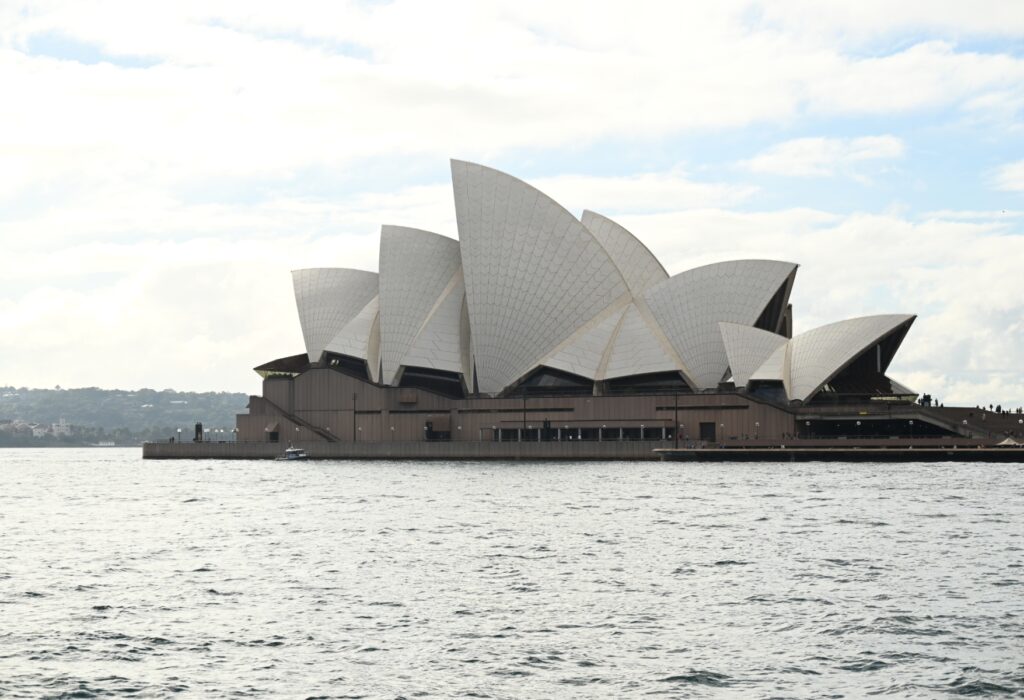
Rather than heading straight to the Opera House, we turn onto the waterfront (which is very pleasant) west of Circular Quay (towards Campbells Cove) to get a better view of the Opera House with the city skyline behind it.
We then climb onto the Sydney Harbour Bridge and walk across it. The view of the city from up there is amazing. We sit down at the tip of Bradfield Park to once again enjoy a stunning view of the city.


From our vantage point, we see gray clouds rolling in and rain starting to fall over the eastern part of the city. We cross the bridge back and take shelter in a Korean restaurant.


When we step outside, the rain has eased, and the sun seems ready to break through. We head back toward the Opera House, this time passing through the Royal Botanic Garden. The garden is free, lush, spacious, and pleasant.
Our opinion on the opera is mixed. Benjamin finds it disappointing and small. François thinks it’s quite nice.
Built in 1973, the UNESCO-listed monument resembles a sailboat ready to set sail on the ocean right beside it.


We head back to Chinatown, where we stop for a snack at a Mixue, the ice cream chain we had discovered in China.



Day 28: We take a stroll through Chinatown. We hope to find souvenirs at more affordable prices than elsewhere in the city. We find a bit of everything, including pieces of kangaroo…


Next, we head to The Rocks district, located very close to the opera. It’s the original neighborhood of Sydney. Prisoners built houses and businesses here to start their new lives on the other side of the planet.
Today, the convicts have been replaced by hipsters. The historic houses are now luxury boutiques. A few plaques here and there tell the story of the neighborhood.
We go to the cinema in the late afternoon. It’s been over 6 months since we last set foot in one. Plus, on Mondays, the screenings are cheaper.


We pick up dessert on the way back.
Day 29: We stroll through the neighborhoods of Surry Hills, Darlinghurst, and Kings Cross. The first two are more residential, and the last is livelier. At least, that’s what the streets we walked through led us to believe.


A large part of these neighborhoods is made up of small terraced houses, some dating back to the early 20th century. It’s really very pretty and peaceful.


We try a crocodile burger for lunch. It tastes like chicken, and the meat is quite crumbly. It falls apart everywhere, but it’s not bad.
We then head back up to the Harbour Bridge, as the sun is shining brightly.
We return to the hotel by taking streets we haven’t explored yet.


Day 30: It’s already the end of our adventure in Australia. We’re back at Sydney Airport. We take a 3-hour flight to Auckland, New Zealand, where we’ll stop over for a few days before continuing our world tour.

Find all our other articles on Australia:


